How Do You Know When Uour Elt Aircragt Is on
ELT Update'Limit your 406 MHz Testing Fourth dimension
Story and Photo past H. Dean Chamberlain
Reprinted with permission from FAA Aviation News
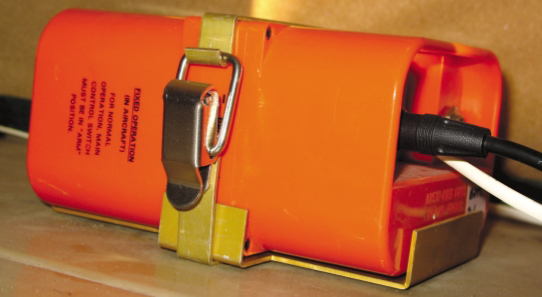
FAA regulations, Title 14 Code of Federal Regulations section 91.207(d)(4), requires that an shipping emergency locator transmitter (ELT) be tested annually for 'the presence of a sufficient point radiated from its antenna.' The Aeronautical Information Manual (AIM) in Chapter six, Department 6-2-v, discusses ELTs, their utilize, and how to test them. To paraphrase a statement from a movie almost a failed trip to the Moon, 'Folks, we take a problem.' The FAA requires an ELT radiated test, but if the test is not done properly, the Federal Communications Commission (FCC) might take enforcement action confronting the person doing a 406 MHz ELT test.
Here is the problem. When the FAA test requirements were written, the basic ELT was an analog 121.5MHz unit transmitting in the aeronautical frequency ring. If the ELT being tested could not exist isolated within an approved radio frequency shielded room or container, which keeps the point from going across the room or container, a radiated test could be done within the first five minutes after the hr. The test requirements listed the number of recommended sweeps of the signal to minimize the gamble of anyone thinking the test signal was an actual distress alert. The person doing the test would quickly activate the ELT, mind for its distinctive sound on a nearby aeronautical ring aircraft radio or hand held transceiver and then turn off the ELT.
This test method met the FAA requirement and nearly organizations were okay with the idea. That was until the newer 406 MHz ELT distress buoy was adult. Part of the problem is that instead of beingness in the aeronautical band, 406 MHz is a protected international distress frequency. Plus, with a properly registered 406MHz ELT, the transmitted betoken includes a digital code that can be used to identify the possessor. Equally a result, the FCC can rails down anyone who, in its opinion, transmits a fraudulent or non-emergency distress signal, e.grand. an FAA test.
Since most 406 MHz ELTs include a depression-powered 121.v MHz homing transmitter, the challenge for the person doing the annual ELT check is how to satisfy the FAA requirement without violating the FCC regulations. Since in most cases the person doing the testing has no way to monitor the406 MHz emitted coded indicate with-out special equipment and can at that place-fore simply mind for the activation of the121.5 MHz homing signal of the combined 406/121.5 MHz ELT.
Short of a change in the regulation, the following is one means of conducting the test. Remember, the purpose of examination is to cheque the shipping's installed organization from ELT transmitter to its antenna.
Anyone testing any ELT should follow the manufacturer's recommended procedures. If those procedures are non available and cannot exist found, the following is one procedure that has been coordinated with the National Oceanic and Atmospheric Administration (NOAA) which operates the Usa portion of the inter-national satellite-based search and rescue arrangement that monitors and processes distress beacon alerts.
Owners of 406 MHz ELTs should limit any exam to less than thirty seconds. This will preclude the satellites from receiving a signal from the 406 MHz buoy when activated to the 'ON' condition or switch position while testing the 121.5 MHz ELT portion of a combined ELT. This volition prevent the regime from initiating a search and rescue action. In that location have been numerous reports of unintentional activation of the combined ELTs when periodic maintenance testing of the 121.5MHz signal is tested to assure proper functioning. Activating the 'ON' function, which is part of the remote command console rather than gaining access to the combined ELT and activating the 'TEST' function, has led to violations administered from the FCC and causes emergency responders to react in an endeavour to locate a downed air craft. If the selection to the 'ON' position is minimized to 30seconds or less, there is sufficient fourth dimension protection to forbid crossing the l-second time threshold for activating the 406MHz locator signal. Operators should advise their maintenance personnel of this limitation and possible vulnerability to violations or sanctions.
The post-obit are excerpts from AIM section 6-2-v, Emergency Locator Transmitter (ELT), dealing with testing, false alarms, and reporting.
Testing1. ELTs should exist tested in accordance with the manufacturer's instructions. This should exist done, preferably, in a shielded or screened room or specially designed exam container to forbid the broadcast of signals, which could trigger a false alert.
two. When this cannot exist done, aircraft operational testing is authorized as follows:
(a) Analog 121.5/243 MHz ELTs should only be tested during the commencement five minutes later on any hour. If operational tests must be made outside of this period, they should exist coordinated with the nearest FAA Control Tower or Flight Ser-vice Station. Tests should exist no longer than 3 aural weeps. If the antenna is removable, a dummy load should be substituted during examination procedures.
(b) Digital 406 MHz ELTs should merely be tested in accord with the unit of measurement's manufacturer's instructions.
(c) Airborne tests are not authorized.
False Alarmsone. Caution should exist exercised to prevent the inadvertent activation of ELTs in the air or while they are existence handled on the ground. Adventitious or unauthorized activation will generate an emergency bespeak that cannot be distinguished from the real thing, leading to expensive and frustrating searches. A false ELT bespeak could besides interfere with genuine emergency transmissions and hinder or prevent the timely location of crash sites. Frequent faux alarms could also event in complacency and de-crease the vigorous reaction that must be attached to all ELT signals.
two. Numerous cases of inadvertent activation have occurred every bit a effect of aerobatics, hard landings, and movement by ground crews, and aircraft maintenance. These false alarms tin can be minimized past monitoring121.five MHz and/or 243.0 MHz as follows:
(a) In flying when a receiver is bachelor.
(b) Before engine shut downward at the terminate of each flight.
(c) When the ELT is handled during installation or maintenance.
(d) When maintenance is being per-formed well-nigh the ELT.
(e) When a ground coiffure moves the aircraft.
(f) If an ELT betoken is heard, turn off the aircraft's ELT to determine if it is transmitting. If it has been activated, maintenance might exist required earlier the unit is returned to the 'ARMED' position. You should contact the nearest Air Traffic facility and notify it of the inadvertent activation.
In flight Monitoring and Reportingi. Pilots are encouraged to monitor121.v MHz and/or 243.0 MHz while in flight to assist in identifying possible emergency ELT transmissions. On receiving a signal, report the following information to the near-est air traffic facility:
(a) Your position at the time the signal was showtime heard.
(b) Your position at the fourth dimension the signal was last heard.
(c) Your position at maximum indicate forcefulness.
(d) Your flight altitudes and frequency on which the emergency signal was heard: 121.v MHz or 243.0 MHz. If possible, positions should exist given relative to a navigation aid. If the aircraft has homing equipment, provide the begetting to the emergency betoken with each re-ported position.
Source: https://iflyamerica.org/elt.asp
0 Response to "How Do You Know When Uour Elt Aircragt Is on"
Post a Comment