The Government Again Demonstrates How Not to Use Fireworks


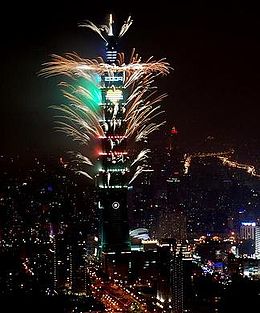
A fireworks display on Taipei 101, Taiwan, which in 2005 held the world's first fireworks display on a supertall skyscraper

Fireworks are a class of low explosive pyrotechnic devices used for artful and entertainment purposes. The almost mutual utilize of a firework is as office of a fireworks display (as well called a fireworks show or pyrotechnics), a display of the effects produced by firework devices.
Fireworks have many forms to produce the iv primary effects: noise, light, smoke, equally well every bit floating materials (confetti most notably). They may exist designed to fire with colored flames and sparks including red, orange, yellow, green, blue, majestic and silver. Displays are common throughout the world and are the focal betoken of many cultural and religious celebrations.
Fireworks are generally classified equally to where they perform, either every bit a ground or aerial firework. In the latter case they may provide their own propulsion (skyrocket) or be shot into the air by a mortar (aerial beat out).
The most common feature of fireworks is a newspaper or pasteboard tube or casing filled with the combustible material, often pyrotechnic stars. A number of these tubes or cases are ofttimes combined so as to make when kindled, a great variety of sparkling shapes, often variously colored. A skyrocket is a common form of firework, although the beginning skyrockets were used in warfare. The aeriform beat, however, is the backbone of today'due south commercial aeriform display, and a smaller version for consumer employ is known as the festival ball in the U.s.a..
Fireworks were originally invented in People's republic of china. Cultural events and festivities such every bit the Chinese New Year and the Mid-Autumn Moon Festival were and even so are times when fireworks are guaranteed sights. China is the largest manufacturer and exporter of fireworks in the globe.
Silent fireworks are condign popular for providing all the beauty without the added explosive sounds imitating arms and warfare that traumatize pets, wild animals, and many humans. The Italian town of Collecchio switched to silent fireworks in 2015,[ane] mandating the switch.
History

An etching of the Royal Fireworks display on the Thames, London, England in 1749

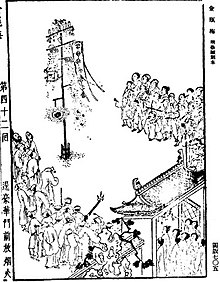
An 18th-century illustration of Chinese fireworks from an English abstract of an account of China past French Jesuit Pierre Nicolas d'Incarville[3]
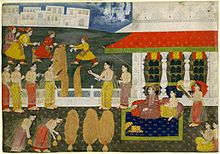
A firework display for Muḥammad Sháh, portrayed seated and leaning confronting a bolster
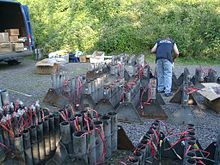
Preparing fireworks at Sayn Castle, Federal republic of germany


A footing firework showing diverse technical parts mentioned in the article, such as the concatenation and a set up of gears

The grand finale showing as well the jets that produce power. A picture taken from the dorsum and so the stars and flowers are not and then conspicuously visible
The earliest fireworks came from China during the Song dynasty (960–1279).[4] Fireworks were used to back-trail many festivities.[5] The art and science of firework making has developed into an independent profession. In Communist china, pyrotechnicians were respected for their knowledge of complex techniques in mounting firework displays.[6]
During the Han dynasty (202 BC – 220 Advertising), people threw bamboo stems into a burn down to produce an explosion with a loud audio.[7] In later times, gunpowder packed into small-scale containers was used to mimic the sounds of burning bamboo.[seven] Exploding bamboo stems and gunpowder firecrackers were interchangeably known as baozhu (爆竹) or baogan (爆竿).[vii] It was during the Song dynasty that people manufactured the first firecrackers comprising tubes made from rolled sheets of paper containing gunpowder and a fuse.[8] They too strung these firecrackers together into large clusters, known as bian (lit. "whip") or bianpao (lit. "whip cannon"), and then the firecrackers could be set off one by one in shut sequence.[viii] Past the twelfth and peradventure the 11th century, the term baozhang (爆仗) was used to specifically refer to gunpowder firecrackers.[7]
During the Song dynasty, many of the common people could purchase various kinds of fireworks from market place vendors.[9] K displays of fireworks were too known to exist held. In 1110, a big fireworks brandish in a martial demonstration was held to entertain Emperor Huizong of Vocal (r. 1100–1125) and his courtroom.[10] A record from 1264 states that a rocket-propelled firework went off well-nigh the Empress Dowager Gong Sheng and startled her during a banquet held in her honour by her son Emperor Lizong of Song (r. 1224–1264).[11] Rocket propulsion was common in warfare, equally evidenced by the Huolongjing compiled by Liu Bowen (1311–1375) and Jiao Yu (fl. c. 1350–1412).[12] In 1240 the Arabs acquired knowledge of gunpowder and its uses from Red china. A Syrian named Hasan al-Rammah wrote of rockets, fireworks, and other incendiaries, using terms that suggested he derived his cognition from Chinese sources, such as his references to fireworks every bit "Chinese flowers".[v] [13]
In regards to colored fireworks, this was derived and developed from earlier (peradventure Han dynasty or shortly thereafter) Chinese application of chemic substances to create colored smoke and fire.[14] Such application appears in the Huolongjing (14th century) and Wubeizhi (preface of 1621, printed 1628), which describes recipes, several of which used low-nitrate gunpowder, to create military signal smokes with various colors.[14] In the Wubei Huolongjing (武備火龍經; Ming, completed after 1628), two formulas appears for firework-like signals, the sanzhangju (三丈菊) and baizhanglian (百丈蓮), that produces silverish sparkles in the smoke.[14] In the Huoxilüe (火戲略; 1753) by Zhao Xuemin (趙學敏), there are several recipes with low-nitrate gunpowder and other chemical substances to tint flames and smoke.[14] These included, for instance, arsenical sulphide for yellowish, copper acetate (verdigris) for light-green, pb carbonate for lilac-white, and mercurous chloride (calomel) for white.[fourteen] The Chinese pyrotechnics were described by the French author Antoine Caillot (1818): "It is certain that the diverseness of colours which the Chinese have the secret of giving to flame is the greatest mystery of their fireworks."[fourteen] Similarly, the English language geographer Sir John Barrow (ca. 1797) wrote "The diversity of colours indeed with which the Chinese have the secret of cloathing fire seems to be the chief merit of their pyrotechny."[14]
Fireworks were produced in Europe by the 14th century, becoming pop by the 17th century.[15] [xvi] [17] Lev Izmailov, ambassador of Peter the Not bad, one time reported from Prc: "They make such fireworks that no one in Europe has ever seen."[17] In 1758, the Jesuit missionary Pierre Nicolas le Chéron d'Incarville, living in Beijing, wrote most the methods and composition on how to make many types of Chinese fireworks to the Paris Academy of Sciences, which revealed and published the business relationship 5 years later.[18] Amédée-François Frézier published his revised work Traité des feux d'artice pour le spectacle (Treatise on Fireworks) in 1747 (originally 1706),[19] covering the recreational and ceremonial uses of fireworks, rather than their military uses. Music for the Royal Fireworks was composed by George Frideric Handel in 1749 to celebrate the Peace treaty of Aix-la-Chapelle, which had been declared the previous twelvemonth.
"Prior to the nineteenth century and the advent of modern chemical science they [fireworks] must have been relatively dull and unexciting."[15] Bertholet in 1786 discovered that oxidations with potassium chlorate resulted in a violet emission. Subsequent developments revealed that oxidations with the chlorates of barium, strontium, copper, and sodium effect in intense emission of bright colors. The isolation of metallic magnesium and aluminium marked another breakthrough as these metals fire with an intense argent light.[15]
Rubber
Improper use of fireworks may be dangerous, both to the person operating them (risks of burns and wounds) and to bystanders; in addition, they may start fires after landing on flammable fabric. For this reason, the use of fireworks is generally legally restricted.[ where? ] Brandish fireworks are restricted by police force[ where? ] for use by professionals; consumer items, available to the public, are smaller versions containing limited amounts of explosive material to reduce potential danger.
Fireworks are also a trouble for animals, both domestic and wild, which tin exist frightened by their dissonance, leading to them running abroad, oftentimes into danger, or hurting themselves on fences or in other ways in an effort to escape.[20] [21] [22] Frightened birds also may carelessness nests and not return to complete rearing their young.[i]
Competitions
Pyrotechnical competitions involving fireworks are held in many countries. The most prestigious fireworks competition is the Montreal Fireworks Festival, an annual contest held in Montreal, Quebec, Canada. Another magnificent competition is Le Festival d'Art Pyrotechnique held in the summertime annually at the Bay of Cannes in Côte d'Azur, France. The Earth Pyro Olympics is an almanac competition amongst the pinnacle fireworks companies in the earth. It is held in Manila, Philippines. The event is one of the largest and most intense international fireworks competitions.
Clubs
Enthusiasts in the United States have formed clubs which unite hobbyists and professionals. The groups provide rubber instruction and organize meetings and private "shoots" at remote premises where members shoot commercial fireworks likewise every bit fire pieces of their own manufacture. Clubs secure permission to burn items otherwise banned past country or local ordinances. Competition among members and between clubs, demonstrating everything from single shells to elaborate displays choreographed to music, are held. One of the oldest clubs is Crackerjacks, Inc.,[23] organized in 1976 in the Eastern Seaboard region of the U.S.
PGI annual convention
The Pyrotechnics Gild International, Inc. or PGI,[24] founded in 1969, is an contained worldwide nonprofit arrangement of amateur and professional fireworks enthusiasts. It is notable for its large number of members, around three,500 in total. The PGI exists solely to further the safe usage and enjoyment of both professional class and consumer grade fireworks while both advancing the art and craft of pyrotechnics and preserving its historical aspects. Each August the PGI conducts its annual week-long convention, where some the world'south biggest and best fireworks displays occur. Vendors, competitors, and guild members come from effectually the US and from diverse parts of the globe to enjoy the show and to help out at this all-volunteer outcome. Aside from the nightly firework shows, the competition is a highlight of the convention. This is a completely unique event where individual classes of hand-built fireworks are competitively judged, ranging from simple fireworks rockets to extremely large and complex aerial shells. Some of the biggest, best, most intricate fireworks displays in the United States take place during the convention week.
Amateur and professional members can come to the convention to buy fireworks, paper goods, novelty items, non-explosive chemic components and much more than at the PGI trade show. Before the nightly fireworks displays and competitions, club members have a hazard to enjoy open shooting of whatever and all legal consumer or professional person grade fireworks, also every bit testing and display of hand-built fireworks. The week ends with the Thou Public Display on Fri night, which gives the called brandish visitor a chance to strut their stuff in front end of some of the earth's biggest fireworks aficionados. The stakes are loftier and much planning is put into the prove. In 1994 a trounce of 36 inches (914 mm) in diameter was fired during the convention, more than than twice as big every bit the largest shell usually seen in the US, and shells as large as 24 inches (610 mm) are oft fired.
Halloween
- Canada
Both fireworks and firecrackers are a popular tradition during Halloween in Vancouver, although apparently this is not the custom elsewhere in Canada.[ citation needed ]
- Republic of ireland
In the Democracy of Ireland and Northern Republic of ireland there are many fireworks displays, during the Halloween season. The largest are in the cities of Belfast, Derry, and Dublin. The 2010 Derry Halloween fireworks attracted an audience of more than 20,000 people.[25] The sale of fireworks is strongly restricted in the Ireland, although many illegal fireworks are sold throughout October or smuggled from Northern Ireland. In the Commonwealth the maximum penalty for possessing fireworks without a licence, or lighting fireworks in a public place, is a €10,000 fine and a v-year prison sentence.[26]
- United states
Two firework displays on All Hallows' Eve in the United States are the annual "Happy Hallowishes" show at Walt Disney World's Magic Kingdom "Mickey'southward Not-And so-Scary Halloween Party" effect, which began in 2005, and the "Halloween Screams" at Disneyland Park, which began in 2009.
Fireworks celebrations throughout the world
Australia
In Australia, fireworks displays are used in the public celebration of major events such equally New year'due south Eve and Australia Twenty-four hour period. Notable almanac fireworks events include the Sydney New year's day's Eve Midnight Fireworks show and the City of Perth Skyworks.
France

In France, fireworks are traditionally displayed on the eve of Guardhouse day (xiv July) to commemorate the French revolution and the storming of the Bastille on that same day in 1789. Every metropolis in France lights up the sky for the occasion with a special mention to Paris that offers a spectacle effectually the Eiffel Belfry.
Hungary
In Republic of hungary fireworks are used on twenty August, which is a national celebration mean solar day [27]
Bharat
Indians throughout the world gloat with fireworks as function of their pop "festival of lights" (Diwali) in Oct-Nov every yr.
Nihon
Video: Extra Large Wide Starmine at the Nagaoka Festival Fireworks 2015, Japan
During the summertime in Japan, fireworks festivals ( 花火大会 , hanabi taikai ) are held nearly every twenty-four hour period someplace in the country, in total numbering more than than 200 during Baronial. The festivals consist of large fireworks shows, the largest of which employ between 100,000 and 120,000 rounds (Tondabayashi, Osaka), and can attract more than 800,000 spectators. Street vendors ready stalls to sell various drinks and staple Japanese food (such as Yakisoba, Okonomiyaki, Takoyaki, Kakigōri (shaved ice), and traditionally held festival games, such every bit Kingyo-sukui, or Goldfish scooping.
Even today, men and women attend these events wearing the traditional Yukata, summer Kimono, or Jinbei (men only), collecting in large social circles of family unit or friends to sit picnic-like, eating and drinking, while watching the show.
The first fireworks festival in Japan was held in 1733.[28]
Sumidagawa Fireworks Festival is one of the many existence historic annually throughout Nippon in summer.
Malta

Fireworks at a Maltese festival in 2014
Fireworks accept been used in Republic of malta for hundreds of years. When the islands were ruled past the Gild of St John, fireworks were used on special occasions such equally the ballot of a new K Chief, the appointment of a new Pope or the birth of a prince.[29]
Nowadays, fireworks are used in hamlet feasts throughout the summer. The Malta International Fireworks Festival is besides held annually.[thirty]
Monte-Carlo International Fireworks Festival
Pyrotechnics experts from around the world accept competed in Monte Carlo, Monaco since 1966. The festival runs from July to August every year, and the winner returns in 18 Nov for the fireworks display on the night before the National Day of Monaco.[31] The event is held in Port Hercule, start at around nine:30pm every night, depending on the sunset.[32]
Singapore

Singapore Fireworks Festival 2006, 8 August 2006
The Singapore Fireworks Celebrations (previously the Singapore Fireworks Festival) is an annual event held in Singapore as part of its National Day celebrations. The festival features local and foreign teams which launch displays on dissimilar nights. While currently non-competitive in nature, the organizer has plans to introduce a competitive element in the future.
The almanac festival has grown in magnitude, from iv,000 rounds used in 2004, to 6,000 in 2005, to more than than 9,100 in 2006.[ citation needed ]
South Korea
Busan International Fireworks Festival is ane of the most significant fireworks festivals in Asia.
Switzerland
In Switzerland fireworks are ofttimes used on ane August, which is a national celebration day.[33]
Great britain
One of the biggest occasions for fireworks in the UK is Guy Fawkes Night held each year on five Nov, to celebrate the foiling of the Catholic Gunpowder Plot on v November 1605, an try to kill Male monarch James I. The Guardian newspaper said in 2008 that United kingdom of great britain and northern ireland's biggest Guy Fawkes night events were:[34]
- Afterwards Dark fireworks, Sheffield homepage
- Bangers on the Beach (Holyhead Round Table charity fireworks), Holyhead homepage
- Battel Blaze in Battle, E Sussex homepage
- Blackheath Fireworks, London homepage [ permanent dead link ]
- Bught Park fireworks, Inverness homepage
- Fireworks with Vikings, Tutbury, Staffordshire homepage
- Flaming Tar Barrels, Ottery St Mary homepage
- Glasgow Green fireworks homepage
- Halloween Happening fireworks, Derry homepage [ permanent expressionless link ]
- Midsummer Mutual, Cambridge homepage
- Sparks in the Park (Cardiff Round Tabular array charity fireworks), Cardiff homepage
The master firework celebrations in the Great britain are by the public who purchase from many suppliers.
Us

America's earliest settlers brought their enthusiasm for fireworks to the Us. Fireworks and black ash were used to celebrate of import events long earlier the American Revolutionary State of war.[ citation needed ] The very first commemoration of Independence Day was in 1777, six years earlier Americans knew whether or non the new nation would survive the war; fireworks were a part of all festivities.[ citation needed ] In 1789, George Washington's inauguration was accompanied by a fireworks display.[ commendation needed ]. George Marshall was an American naval hero during the State of war of 1812 and other campaigns. He was a Chief Gunner and pyrotechnics specialist who wrote Marshall'due south Practical Marine Gunnery in 1822. The volume outlines chemical formulas for the composition of fireworks.[35] This early on fascination with fireworks' dissonance and color continues today with fireworks displays commonly included in Independence Day celebrations.
In 2004, Disneyland, in Anaheim, California, pioneered the commercial use of aerial fireworks launched with compressed air rather than gunpowder. The display beat explodes in the air using an electronic timer. The advantages of compressed air launch are a reduction in fumes, and much greater accurateness in height and timing.[36] The Walt Disney Visitor is now the largest consumer of fireworks in the world.[37]
Uses other than public displays
In add-on to large public displays, people oftentimes buy modest quantities of fireworks for their ain celebrations. Fireworks on general sale are commonly less powerful than professional fireworks. Types include firecrackers, rockets, cakes (multishot aerial fireworks), and smoke balls.
Fireworks can besides be used in an agricultural capacity every bit to frighten abroad birds.
Pyrotechnic compounds

Copper compounds glow light-green or blue-green in a flame
Colors in fireworks are usually generated by pyrotechnic stars —usually just chosen stars —which produce intense light when ignited. Stars contain 5 basic types of ingredients.
- A fuel
- An oxidizer—a compound that combines with the fuel to produce intense heat
- Colour-producing salts (when the fuel itself is not the colorant)
- A binder which holds the pellet together.
Some of the more than common color-producing compounds are tabulated here. The color of a compound in a firework volition be the aforementioned as its colour in a flame exam (shown at right). Not all compounds that produce a colored flame are appropriate for coloring fireworks, notwithstanding. Ideal colorants volition produce a pure, intense color when nowadays in moderate concentration.
The color of sparks is limited to red/orange, yellow/gold and white/silver. This is explained by lite emission from an incandescent solid particle in dissimilarity to the element-specific emission from the vapor phase of a flame.[38] Calorie-free emitted from a solid particle is divers by black-torso radiation. Low boiling metals can form sparks with an intensively colored glowing vanquish surrounding the bones particle.[39] This is caused by vapor phase combustion of the metallic.
| Color | Metal | Example compounds |
|---|---|---|
| Blood-red | Strontium (intense scarlet) Lithium (medium blood-red) | SrCO3 (strontium carbonate) Li2CO3 (lithium carbonate) LiCl (lithium chloride) |
| Orange | Calcium | CaCl2 (calcium chloride) |
| Xanthous | Sodium | NaNO3 (sodium nitrate) |
| Green | Barium | BaCl2 (barium chloride) |
| Blueish | Copper halides | CuCl2 (copper chloride), at low temperature |
| Indigo | Caesium | CsNO3 (caesium nitrate) |
| Violet | Potassium Rubidium (violet-ruby) | KNOiii (potassium nitrate) RbNOiii (rubidium nitrate) |
| Gold | Charcoal, iron, or lampblack | |
| White | Titanium, aluminium, beryllium, or magnesium powders | |
The brightest stars, often called Mag Stars, are fueled past aluminium. Magnesium is rarely used in the fireworks industry due to its lack of ability to form a protective oxide layer. Often an alloy of both metals called magnalium is used.
Many of the chemicals used in the manufacture of fireworks are non-toxic, while many more have some degree of toxicity, can cause skin sensitivity, or be in dust class and are thereby inhalation hazards. Still others are poisons if directly ingested or inhaled.
Common elements in pyrotechnics
The post-obit tabular array lists the principal elements used in mod pyrotechnics. Some elements are used in their elemental class such as particles of titanium, aluminium, iron, zirconium, and magnesium. These elements burn in the presence of air (O2) or oxidants (perchlorate, chlorate). Most elements in pyrotechnics are in the grade of salts.[xv]
| Symbol | Proper name | Fireworks Usage |
|---|---|---|
| | Aluminium | Aluminium metal is used to produce silver and white flames and sparks. It is a common component of sparklers. |
| | Barium | Barium salts are used to create dark-green colors in fireworks, and it can also help stabilize other volatile elements. |
| | Carbon | Carbon is one of the main components of black powder, which is used as a propellent in fireworks. Carbon provides the fuel for a firework. Mutual forms include carbon black, sugar, or starch. |
| | Chlorine | Chlorate and perchlorates are common oxidizers. |
| | Copper | Copper compounds produce blue colors. |
| | Iron | Iron powder is used to produce sparks in sparklers. |
| | Potassium | Potassium nitrate, potassium chlorate, and potassium perchlorate are common oxidizers. The potassium content impart a faint violet color to the sparks. |
| | Magnesium | Magnesium metal burns a very vivid white, so it is used to add white sparks or better the overall luminescence of a firework. |
| | Sodium | Sodium imparts a gold or xanthous color to fireworks, withal, the colour is ofttimes so bright that it oft masks other, less intense colors. Sodium lamps operate with the same optical emission. |
| | Oxygen | Oxygen is a component of chlorate and perchlorate, mutual oxidizers. |
| | Sulfur | Sulfur is a component of black pulverisation, and as such, it is institute in a propellant/fuel. |
| | Strontium | Strontium salts impart a reddish color. |
| | Titanium | Titanium metallic tin can be burned as powder or flakes to produce silver sparks. |
| | Zirconium | Zirconium, like titanium, burns to produce oxides that emit brightly. It is used in "waterfalls". |
Types of effects
Cake
A cake is a cluster of individual tubes linked past fuse that fires a series of aerial effects. Tube diameters can range in size from i⁄4 –four inches (6.four–101.half dozen mm), and a unmarried cake can have more than 1,000 shots. The variety of effects within individual cakes is often such that they defy descriptive titles and are instead given cryptic names such as "Bermuda Triangle", "Pyro Glyphics", "Waco Wakeup", and "Poisonous Spider", to name a few. Others are simply quantities of two.5–four in (64–102 mm) shells fused together in single-shot tubes.
Crossette
A crush containing several large stars that travel a brusk distance before breaking apart into smaller stars, creating a crisscrossing grid-like result. Strictly speaking, a crossette star should split up into 4 pieces which fly off symmetrically, making a cross. Once limited to silver or gold effects, colored crossettes such every bit red, dark-green, or white are at present very common.
Chrysanthemum

Chrysanthemum shells in New York
A spherical intermission of colored stars, like to a peony, but with stars that leave a visible trail of sparks.
Dahlia
Essentially the same as a peony trounce, only with fewer and larger stars. These stars travel a longer-than-usual distance from the shell suspension before burning out. For instance, if a 3 in (76 mm) peony shell is made with a star size designed for a 6 in (152 mm) shell, it is then considered a dahlia. Some dahlia shells are cylindrical rather than spherical to allow for larger stars.
Diadem
A type of Chrysanthemum or Peony, with a center cluster of non-moving stars, ordinarily of a contrasting color or effect.
Fish
Inserts that propel themselves rapidly away from the vanquish burst, oft resembling fish pond away.
Horsetail
Named for the shape of its break, this shell features heavy long-burning tailed stars that only travel a curt altitude from the shell burst earlier free-falling to the basis. Likewise known as a waterfall shell. Sometimes at that place is a glittering through the "waterfall".
Kamuro

Kamuro is a Japanese discussion meaning "boys haircut", which is what this shell resembles when fully exploded in the air. It is a dense burst of glittering silvery or gold stars which get out a heavy glitter trail and shine bright in the night'south heaven.
Mine
A mine (a.k.a. pot à feu) is a footing firework that expels stars and/or other garnitures into the sky. Shot from a mortar like a shell, a mine consists of a canister with the lift accuse on the bottom with the effects placed on top. Mines can project small reports, serpents, small shells, equally well every bit just stars. Although mines up to 12 inches (305 mm) diameter announced on occasion, they are usually between iii–five inches (76–127 mm), in diameter.
Multi-suspension shells
A large trounce containing several smaller shells of various sizes and types. The initial outburst scatters the shells beyond the sky before they explode. Also called a bouquet crush. When a shell contains smaller shells of the same size and type, the effect is unremarkably referred to every bit "Thousands". Very large bouquet shells (up to 48 inches [1,219 mm]) are ofttimes used in Japan.
- Bang
The bang is the about common event in fireworks and sounds like artillery cannon being fired; technically a "report". Silent fireworks have all of the visual effects, all the same. The "salute" outcome is fifty-fifty more pronounced and sometimes is banned. - Crackle
The firework produces a crackling sound. - Hummer
Tiny tube fireworks that are ejected into the air spinning with such force that they shred their outer coating, in doing so they whizz and hum. - Whistle
High pitched often very loud screaming and screeching created by the resonance of gas. This is acquired by a very fast strobing (on/off burning stage) of the fuel. The rapid bursts of gas from the fuel vibrate the air many hundreds of times per second causing the familiar whistling sound. It is not, as is usually idea, made in the conventional fashion that musical instruments are using specific tube shapes or apertures. Common whistle fuels comprise benzoate or salicylate compounds and a suitable oxidizer such as potassium perchlorate.
Palm
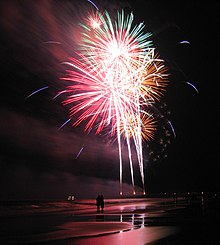
A vanquish containing a relatively few large comet stars arranged in such a way as to burst with large arms or tendrils, producing a palm tree-similar effect. Proper palm shells feature a thick rising tail that displays as the shell ascends, thereby simulating the tree trunk to further enhance the "palm tree" outcome. I might besides run into a flare-up of color inside the palm flare-up (given by a small insert trounce) to simulate coconuts.
Peony
A spherical break of colored stars that fire without a tail effect. The peony is the most normally seen shell type.
Ring
A shell with stars specially arranged then equally to create a ring. Variations include smiley faces, hearts, and clovers.
Roman candle
A Roman candle is a long tube containing several large stars which fire at a regular interval. These are commonly arranged in fan shapes or crisscrossing shapes, at a closer proximity to the audience. Some larger Roman candles comprise small shells (bombettes) rather than stars.
Salute
A shell intended to produce a loud report rather than a visual effect. Salute shells usually contain wink pulverisation, producing a quick flash followed by a very loud report resembling military artillery. Titanium may exist added to the flash powder mix to produce a deject of bright sparks around the flash. Salutes are usually used in large quantities during finales to create intense noise and brightness. They are ofttimes cylindrical in shape to allow for a larger payload of flash pulverization, but brawl shapes are common and cheaper as well. Salutes are also chosen Maroons.
Spider
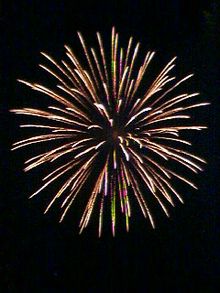
A shell containing a fast burning tailed or charcoal star that is burst very hard and then that the stars travel in a straight and flat trajectory earlier slightly falling and burning out. This appears in the sky every bit a series of radial lines much like the legs of a spider.
Time Rain
An effect created past large, tedious-burning stars within a beat out that go out a trail of large glittering sparks behind and make a sizzling noise. The "time" refers to the fact that these stars burn away gradually, every bit opposed to the standard brocade "pelting" upshot where a big amount of glitter material is released at in one case.
Willow
Similar to a chrysanthemum, but with long-burning silver or gilt stars that produce a soft, dome-shaped weeping willow-like event.
Farfalle
Farfalle is an issue in Italian fireworks with spinning silver sprays in the air.
Tourbillion
Like to a Farfalle but has spinning stars[ clarification needed ]
Hazards and regulation
Safety


Fireworks pose risks of injury to people, and of damage, largely as a fire hazard. The explosions added to fireworks may affright and traumatize animals and people. Wildlife may die while fleeing in a panic and in afflicted areas birds may carelessness forever nests containing their young.[1]
Pollution

Haze caused by smoke from fireworks, combined with smoke from wildfires few miles abroad from where the photo was taken
Fireworks produce smoke and dust that may incorporate residues of heavy metals, sulfur-coal compounds and some low concentration toxic chemicals. These past-products of fireworks combustion will vary depending on the mix of ingredients of a particular firework. (The colour green, for instance, may exist produced by adding the diverse compounds and salts of barium, some of which are toxic, and some of which are not.) Some fishers have noticed and reported to ecology authorities that firework residues tin can hurt fish and other water-life because some may contain toxic compounds (such as antimony sulfide[xl] [41] [42] [43] or arsenic[44]). This is a subject of much contend due to the fact that big-calibration pollution from other sources makes information technology difficult to measure the amount of pollution that comes specifically from fireworks. The possible toxicity of whatever fallout may also be afflicted by the amount of black pulverization used, blazon of oxidizer, colors produced and launch method.
Perchlorate salts, when in solid form, deliquesce and motion rapidly in groundwater and surface water. Even in low concentrations in drinking water supplies, perchlorate ions are known to inhibit the uptake of iodine past the thyroid gland. Every bit of 2010, in that location are no federal drinking water standards for perchlorates in the United States, but the United states of america Environmental Protection Agency has studied the impacts of perchlorates on the environment as well as drinking water.[45]
Several U.S. states have enacted drinking water standard for perchlorates, including Massachusetts in 2006. California'south legislature enacted AB 826, the Perchlorate Contamination Prevention Act of 2003, requiring California's Department of Toxic Substance Control (DTSC) to adopt regulations specifying best management practices for perchlorate-containing substances. The Perchlorate Best Management Practices were adopted on 31 December 2005 and became operative on i July 2006.[46] California issued drinking water standards in 2007. Several other states, including Arizona, Maryland, Nevada, New Mexico, New York, and Texas have established non-enforceable, advisory levels for perchlorates.
The courts take also taken activity with regard to perchlorate contamination. For case, in 2003, a federal commune courtroom in California found that Comprehensive Environmental Response, Compensation and Liability Deed (CERCLA) applied considering perchlorate is ignitable and therefore a "feature" hazardous waste.[47]
Pollutants from fireworks heighten concerns because of potential wellness risks associated with hazardous by-products. For most people the effects of exposure to low levels of toxins from many sources over long periods are unknown. For persons with asthma or multiple chemical sensitivity the fume from fireworks may beal existing wellness problems.[48]
Pollution is also a concern because fireworks ofttimes contain heavy metals as source of colour.[49] [l] Notwithstanding, gunpowder fume and the solid residues are basic, and equally such the net effect of fireworks on acrid rain is debatable.[ commendation needed ] What is non disputed is that nearly consumer fireworks get out backside a considerable amount of solid debris, including both readily biodegradable components as well every bit nondegradable plastic items. Concerns over pollution, consumer safety, and debris accept restricted the auction and use of consumer fireworks in many countries. Professional displays, on the other mitt, remain popular around the world.
Others argue that alleged concern over pollution from fireworks constitutes a blood-red herring, since the corporeality of contamination from fireworks is minuscule in comparing to emissions from sources such equally the called-for of fossil fuels. In the Us, some states and local governments restrict the utilise of fireworks in accordance with the Clean Air Act which allows laws relating to the prevention and control of outdoor air pollution to be enacted. Few governmental entities, by dissimilarity, finer limit pollution from burning fossil fuels such as diesel fuel fuel or coal. Coal-fueled electricity generation lone is a much greater source of heavy metal contamination in the environment than fireworks.
Some companies within the U.Due south. fireworks manufacture merits they are working with Chinese manufacturers to reduce and ultimately hope to eliminate of the pollutant perchlorate.[51]
Authorities regulations around the world
Commonwealth of australia

Fireworks are illegal in almost Australian states and territories, unless part of a display past a licensed pyrotechnician and with a permit.[52] [53] Nonetheless Tasmania, ACT and Northern Territory allow consumer use with a allow (dependent on agenda date and circumstances).[54] On 1 July for Territory Day you can freely use fireworks without a permit in the Northern Territory.[55]
Pocket-sized novelties such as party poppers and sparklers are legal for consumers across Australia.
On 24 August 2009, the ACT Government announced a complete ban on backyard fireworks.[56]
Canada
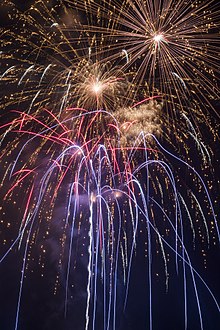
The use, storage and sale of commercial-grade fireworks in Canada is licensed by Natural Resource Canada'south Explosive Regulatory Division (ERD). Unlike their consumer counterpart, commercial-grade fireworks function differently, and come in a wide range of sizes from 50 mm (2 inches) up to 300 mm (eleven+ thirteen⁄xvi inches) or more in diameter. Commercial grade fireworks require a Fireworks Operator Certificate (FOC), obtained from the ERD by completing a ane-day safety course. There are two categories of FOC: one for pyrotechnics (those used on stage and in movies) and another for display fireworks (those used in dedicated fireworks shows). Each requires completion of its own course, although there are special categories of FOC which allow visiting operators to run their shows with the assistance of a Canadian supervisor.
The display fireworks FOC has ii levels: assistant (which allows y'all to work under a qualified supervisor until you are familiar with the nuts), and fully licensed. A fully licensed brandish fireworks operator can also exist further endorsed for marine launch, flight saucers, and other more technically demanding fireworks displays.
The pyrotechnician FOC has 3 levels: pyrotechnician (which allows work under a supervisor), supervising pyrotechnician, and special effects pyrotechnician (which allows the fabrication of sure types of pyrotechnic devices). Additionally, a special furnishings pyrotechnician can exist endorsed for the employ of detonating string.
Since commercial-grade fireworks are shells which are loaded into dissever mortars by hand, there is danger in every phase of the setup.[57] Setup of these fireworks involves the placement and securing of mortars on wooden or wire racks; loading of the shells; and if electronically firing, wiring and testing. The mortars are generally made of FRE (fiber-reinforced epoxy) or HDPE (high-density polyethylene). Older mortars made of sheet steel have been banned by most countries due to the trouble of shrapnel produced during a misfire.
Setup of mortars in Canada for an oblong firing site require that a mortar be configured at an angle of 10 to xv degrees down-range with a safety distance of at least 200 meters (660 ft) down-range and 100 meters (330 ft) surrounding the mortars, plus altitude adjustments for wind speed and direction. In June 2007, the ERD approved circular firing sites for utilize with vertically fired mortars with a safety distance of at least 175-meter (574 ft) radius, plus distance adjustments for wind speed and management.[58]
Loading of shells is a frail process, and must be done with caution, and a loader must ensure not only the mortar is clean, simply as well make sure that no part of their body is directly over the mortar in case of a premature fire. Wiring the shells is a painstaking process; whether the shells are being fired manually or electronically, any "chain fusing" or wiring of electrical ignitors, care must be taken to prevent the fuse (an electrical match, often incorrectly chosen a squib) from igniting. If the setup is wired electrically, the electrical matches are usually plugged into a "firing rail" or "breakout box" that runs back to the main firing board; from there, the Firing Board is simply hooked up to a auto battery, and can continue with firing the show when ready.
Since commercial-class fireworks are so much larger and more powerful, setup, and firing crews are ever under great pressure level to ensure they safely gear up, burn down, and clean up afterward a prove.
Republic of chile
In Chile, the manufacture, importation, possession and use of fireworks is prohibited to unauthorized individuals; only certified firework companies can legally use fireworks. As they are considered a type of explosive, offenders tin can in principle exist tried before military machine courts, although this is unusual in practise.
China
European Union

The European Spousal relationship's policy is aimed at harmonising and standardising the EU fellow member states' policies on the regulation of production, transportation, sale, consumption and overall rubber of fireworks across Europe.[59]
Belgium
In Kingdom of belgium, each municipality can decide how to regulate fireworks. During New Year'due south Eve, lighting fireworks without a licence is allowed in 35% of the 308 Flemish municipalities, in effectually 50% a allow from the burgemeester (mayor) is required, and around 14% of municipalities have banned consumer fireworks altogether.[60]
Finland

Fireworks on Baronial 30, 2014 in Tampere, Finland
In Finland those under 18 years old haven't been allowed to purchase any fireworks since 2009. Safe goggles are required. The use of fireworks is mostly allowed on the evening and dark of New Yr's Eve, 31 December. In some municipalities of Western Republic of finland it is allowed to utilize fireworks without a fire station's permission on the concluding weekend of Baronial. With the fire station's permission, fireworks can be used year-round.[ citation needed ]
Federal republic of germany
In Germany, amateurs over 18 years old are allowed to buy and ignite fireworks of Category F2 for several hours on 31 Dec and 1 January; each German municipality is authorised to limit the number of hours this may last locally.[61] The sale of Category F3 and F4 fireworks to consumers is prohibited.[60] Lighting fireworks is forbidden well-nigh churches, hospitals, retirement homes and wooden or thatch-roofed buildings.[60] All major German cities organise professional fireworks shows.[60]
In addition to the previously existing regulations, there was a nationwide ban on the sale of category F2 fireworks to consumers on New Year's Eve 2020/2021 during the COVID-xix pandemic, with the aim to relieve the burden on hospitals by reducing the number of emergencies due to injuries acquired past fireworks on New Year'due south Eve.[62]
Italy
In 2015, the Italian town of Collecchio mandated silent fireworks,[1] existence among the first to make the switch without losing the beauty of the visual displays.
Netherlands
In holland, fireworks cannot be sold to anyone under the age of sixteen. It may only be sold during a period of three days before a new year's day. If one of these days is a Lord's day, that day is excluded from sale and sale may commence one day earlier.[63]
Democracy of Ireland
In the Democracy of Ireland, fireworks are illegal and possession is punishable by huge fines and/or prison house. However, around Halloween a big amount of fireworks are fix off, due to the ease of being able to purchase from Northern Ireland.
Sweden
In Sweden, fireworks can only be purchased and used by people 18 or older. Burn down crackers used to be banned, merely are now allowed under Eu fireworks policy.
Iceland
In Iceland, the Icelandic police states that anyone may buy and use fireworks during a sure catamenia around New year's day's Eve. Most places that sell fireworks in Republic of iceland brand their own rules about historic period of buyers, usually it is effectually xvi. The people of Reykjavík spend enormous sums of money on fireworks, nigh of which are fired as midnight approaches on 31 December. As a result, every New year's day's Eve the city is lit upward with fireworks displays.
New Zealand
Fireworks in New Zealand are available from 2 to 5 November, around Guy Fawkes Day, and may be purchased only by those 18 years of historic period and older (up from 14 years pre-2007). Despite the restriction on when fireworks may be sold, there is no restriction regarding when fireworks may be used. The types of fireworks available to the public are multi-shot "cakes", Roman candles, single shot shooters, ground and wall spinners, fountains, cones, sparklers, and various novelties, such as smoke bombs and Pharaoh's serpents. Consumer fireworks are as well non allowed to exist louder than 90 decibels.[64]
Norway
In Norway, fireworks can only be purchased and used by people 18 or older. Sale is restricted to a few days before New Twelvemonth'southward Eve. Rockets are not allowed.[65]
Uk

Fireworks in the UK take become more strictly regulated since 1997. Since 2005, the police force has been harmonised gradually, in accordance with other EU member state laws.
Fireworks are mostly used in England, Scotland and Wales effectually Diwali, in late October or early Nov, and Guy Fawkes Nighttime, v Nov. In the UK, responsibleness for the rubber of firework displays is shared between the Health and Safety Executive, burn down brigades and local authorities. Currently, there is no national system of licensing for fireworks operators, but in guild to purchase brandish fireworks, operators must have licensed explosives storage and public liability insurance.
Fireworks cannot be sold to people under the age of 18 and are non permitted to be prepare off betwixt 11pm and 7am with exceptions only for:
- Bonfire Night (5 November) (permitted until midnight)[66]
- The Chinese New year (permitted until 1am)[66]
- Diwali (permitted until 1am)[66]
- New year (permitted until midnight New Year'southward Eve, and standing to be permitted until 1am)[66]
The maximum legal NEC (net explosive content) of a United kingdom firework bachelor to the public is ii kilograms. Jumping jacks, strings of firecrackers, beat out firing tubes, bangers and mini-rockets were all banned during the tardily 1990s. In 2004, unmarried-shot air bombs and bottle rockets were banned, and rocket sizes were limited. From March 2008 any firework with more than than 5% flashpowder per tube has been classified 1.3G.[ clarification needed ] The aim of these measures was to eliminate "pocket money" fireworks, and to limit the confusing effects of loud bangs.[67]
Usa
In the Us, the laws governing fireworks vary widely from state to country, or from county to county. Federal, state, and local authorities govern the use of display fireworks in the Usa. At the federal level, the Consumer Product Safety Commission (CPSC) regulates consumer fireworks through the Federal Hazardous Substances Human action (FHSA). The National Burn down Protection Association (NFPA) sets along a ready of codes that give the minimum standards of brandish fireworks employ and safety in the U.Southward. Both country and local jurisdictions can further add restrictions on the utilize and safety requirements of display fireworks. There are currently 46 states in the U.s.a. in which fireworks are legal for consumer utilize.[68]

References
- ^ a b c d Smith, Andrea, Why this Italian town is switching to silent fireworks, Lonely Planet, July v, 2018
- ^ Needham, Joseph (1986). Science and Civilisation in Prc, Book 5: Chemical science and Chemical Technology, Part seven: Military Technology: The Gunpowder Epic. Cambridge University Press. p. 140. ISBN0-521-30358-three.
- ^ Needham, Joseph (1986). Science and Civilisation in Mainland china, Volume 5: Chemistry and Chemic Technology, Office seven: Military Technology: The Gunpowder Epic. Cambridge University Press. p. 142. ISBN0-521-30358-3.
- ^ Gernet, Jacques (1962). Daily Life in Red china on the Eve of the Mongol Invasion, 1250–1276. Translated by H.Chiliad. Wright. Stanford: Stanford University Press. Page 186. ISBN 0-8047-0720-0.
- ^ a b Temple, Robert Thou.G. (2007). The Genius of People's republic of china: 3,000 Years of Science, Discovery, and Invention (third edition). London: André Deutsch, pp. 256–66. ISBN 978-0-233-00202-6
- ^ Hutchins, Paul (2009). The surreptitious doorway: Beyond imagination. Imagination Publishing. p. 27. ISBN978-0-9817123-3-eight.
- ^ a b c d Needham, Joseph (1986). Science and Civilisation in China, Volume v: Chemistry and Chemical Technology, Part vii: Military Engineering: The Gunpowder Epic. Cambridge University Printing. pp. 128–31. ISBN0-521-30358-3.
- ^ a b Yuan, Haiwang (2008). "Chinese Fireworks". DLPS Faculty Publications.
- ^ Gernet, Jacques (1962). Daily Life in China on the Eve of the Mongol Invasion, 1250–1276. Translated past H.M. Wright. Stanford: Stanford Academy Press, pp. 186. ISBN 0-8047-0720-0.
- ^ Kelly, Jack (2004). Gunpowder: Alchemy, Bombards, and Pyrotechnics: The History of the Explosive that Changed the Globe. New York: Bones Books, Perseus Books Group, page 2.
- ^ Crosby, Alfred W. (2002), Throwing Burn down: Projectile Technology Through History. Cambridge: Cambridge University Press. ISBN 0-521-79158-8. pp. 100–03.
- ^ Needham, Volume 5, Role seven, 489–503.
- ^ Kelly, Jack (2004). Gunpowder: Alchemy, Bombards, & Pyrotechnics: The History of the Explosive that Changed the Globe. Bones Books, page 22. ISBN 0-465-03718-six.
- ^ a b c d eastward f g Needham, Joseph (1986). Science and Civilisation in Mainland china, Volume v: Chemistry and Chemic Technology, Part 7: Military machine Engineering science: The Gunpowder Epic. Cambridge University Press. pp. 144–46. ISBN0-521-30358-3.
- ^ a b c d T. T. Griffiths, U. Krone, R. Lancaster (2017). "Pyrotechnics". Ullmann's Encyclopedia of Industrial Chemistry. Weinheim: Wiley-VCH. doi:10.1002/14356007.a22_437.pub2.
{{cite encyclopedia}}: CS1 maint: multiple names: authors list (link) - ^ "The Evolution of Fireworks", Smithsonian Scientific discipline Educational activity Middle. ssec.si.edu.
- ^ a b Werrett, Simon (2010). Fireworks: Pyrotechnic arts and sciences in European history. Chicago: The University of Chicago Press. p. 181. ISBN978-0-226-89377-8.
- ^ Werrett, Simon (2010). Fireworks: Pyrotechnic arts and sciences in European history. Chicago: The University of Chicago Press. p. 183. ISBN978-0-226-89377-8.
- ^ Werrett, Simon (2010). Fireworks: Pyrotechnic arts and sciences in European history. Chicago: The Academy of Chicago Printing. pp. 144–45. ISBN978-0-226-89377-8.
- ^ "Fireworks Affright Animals". Animal Aid. 26 October 2007. Archived from the original on 17 September 2010. Retrieved 24 June 2010.
- ^ "Fireworks Thunder and Pets – Condom considerations for noise phobias". Vetmedicine.about.com. Archived from the original on 30 August 2009. Retrieved 24 June 2010.
- ^ "How should I care for my pets during fireworks displays?". Kb.rspca.org.au. 17 August 2009. Archived from the original on 13 Nov 2009. Retrieved 24 June 2010.
- ^ "CrackerJacks". Archived from the original on 23 May 2016. Retrieved three May 2016.
- ^ "PGI (Pyrotechnics Social club International)". Archived from the original on 17 May 2016. Retrieved iii May 2016.
- ^ "Banks of the Foyle Halloween Carnival". Derry Metropolis. 2010. Archived from the original on 21 July 2006. Retrieved 5 September 2006.
- ^ Barry, Aoife (27 October 2013). "Alarm over fireworks danger – and €10,000 fine for using them illegally". The Journal . Retrieved 8 February 2018.
- ^ 20. August-St. Stephen's Solar day https://www.budapestbylocals.com/upshot/august-20th/ Archived 13 December 2017 at the Wayback Machine 20170823
- ^ "Summer: the flavor of 'fire flowers'". The Japan Times. Archived from the original on 25 July 2010. Retrieved iii May 2016.
- ^ "The History of Fireworks in Malta". uniqueholidaymalta.com. Archived from the original on eight February 2015. Retrieved viii February 2015.
- ^ "Festas in Malta & Gozo". malta.com. Archived from the original on xiv February 2015. Retrieved viii February 2015.
- ^ "Monaco – July/August: Monte-Carlo International Fireworks Festival". www.visitmonaco.com. Archived from the original on 15 July 2011. Retrieved 9 November 2015.
- ^ "Monaco's International Fireworks Festival is back this July and Baronial". 16 July 2015. Retrieved ix November 2015.
- ^ "Take care around fireworks, Swiss told". The Local.ch. 26 July 2016. Retrieved 5 July 2017.
- ^ Wills, Dixe (30 Oct 2008). "ten best bonfire night celebrations in the U.k.". The Guardian . Retrieved 3 May 2016.
- ^ Marshall, George (1822). Marshall's Applied Marine Gunnery. Norfolk VA: C. Hall. p. 110.
- ^ Walt Disney Company (28 June 2004). "Disney debuts new safer, quieter and more environmentally-friendly fireworks technology". Press Release. Archived from the original on 26 November 2004.
- ^ Cindy Robinson; Jon Jefferson; Les Wooten (2006). Modern Marvels - Walt Disney World (History Aqueduct) (DVD). New York: A&Eastward Television Networks. Event occurs at 44 minutes. ASIN B000CS461O. ISBN9780767087896. OCLC 64282449.
- ^ Kosanke, Kenneth L.; Kosanke, Bonnie J.; Jennings-White, C. (1999). "Pyrotechnic Spark Generation". Selected Pyrotechnic Publications of K. L. and B. J. Kosanke, Part four: 1995 Through 1997. Journal of Pyrotechnics. pp. 49–62. ISBN978-1-889526-12-6.
- ^ Lederle, Felix; Koch, Jannis; Hübner, Eike One thousand. (21 February 2019). "Colored Sparks". European Journal of Inorganic Chemistry. 2019 (seven): 928–37. doi:10.1002/ejic.201801300. S2CID 104449284.
- ^ Shimizu, Takeo (1997). "Some Techniques for Manufacturing Fireworks". Selected Pyrotechnic Publications of Dr. Takeo Shimizu Part 2: Translated Articles. Journal of Pyrotechnics. pp. 21–. ISBN978-ane-889526-ten-2.
- ^ Camilleri, Renato; Vella, Alfred J. (November 2010). "Effect of fireworks on ambient air quality in Malta". Atmospheric Environment. 44 (35): 4521–4527. Bibcode:2010AtmEn..44.4521C. doi:10.1016/j.atmosenv.2010.07.057.
- ^ Junyi, Due west., Haicheng, H., & Zhenbing, T. (2019). Research on rapid qualitative detection of antimony in pyrotechnic powder used for fireworks and firecrackers.
- ^ Steinhauser, Georg; Klapötke, Thomas K. (12 January 2010). "Using the Chemistry of Fireworks To Engage Students in Learning Basic Chemic Principles: A Lesson in Eco-Friendly Pyrotechnics". Journal of Chemical Instruction. 87 (2): 150–156. Bibcode:2010JChEd..87..150S. doi:x.1021/ed800057x.
- ^ Sterba, Johannes H.; Steinhauser, Georg; Grass, Fritz (Apr 2013). "Illicit utilization of arsenic compounds in pyrotechnics? An analysis of the suspended particle emission during Vienna'southward New year fireworks". Journal of Radioanalytical and Nuclear Chemical science. 296 (1): 237–243. doi:10.1007/s10967-012-2001-x. S2CID 97761513.
- ^ "Perchlorate | Drinking Water Contaminants | Safewater | Water | US EPA". Epa.gov. Archived from the original on 1 December 2006. Retrieved 24 June 2010.
- ^ "Perchlorate". Dtsc.ca.gov. Archived from the original on 23 August 2009. Retrieved 24 June 2010.
- ^ Castaic Lake H2o Agency v. Whittaker, 272 F. Supp. 2d 1053, 1059-61 (C.D. Cal. 2003)
- ^ New Scientist – Peachy fireworks, shame almost the toxic fallout
- ^ "Mutual Fireworks Release Pb, Copper & Other Toxic Metals into the Air". NYU Langone News . Retrieved nineteen September 2021.
- ^ Hickey, Christina; Gordon, Christopher; Galdanes, Karen; Blaustein, Martin; Horton, Lori; Chillrud, Steven; Ross, James; Yinon, Lital; Chen, Lung Chi; Gordon, Terry (2 July 2020). "Toxicity of particles emitted by fireworks". Particle and Fibre Toxicology. 17 (one): 28. doi:10.1186/s12989-020-00360-4. ISSN 1743-8977. PMC7330945. PMID 32611421.
- ^ Knee joint, Karen. Philadelphia Inquirer. 4 Jul 2009. Pa. company works to brand fireworks greener
- ^ "Fireworks". SafeWork NSW. 17 Baronial 2018. Retrieved xv Nov 2020.
- ^ "Fireworks & SFX licences". SafeWork SA. xxx June 2020. Retrieved 15 November 2020.
- ^ "Fireworks licences and permits". ACT Government. 29 June 2020. Retrieved 15 Nov 2020. [ permanent expressionless link ]
- ^ "Disposal of shopgoods fireworks". NT WorkSafe. 13 Oct 2020. Retrieved xv November 2020.
- ^ "Cracker down: Act bans fireworks". Australian Broadcasting Corporation. 24 Baronial 2009. Retrieved 24 Baronial 2009.
- ^ Natural Resource Canada, Explosive Regulatory Division. Display Fireworks Manual (March 2002 Edition)
- ^ Natural Resources Canada Explosive Branch Message #48
- ^ Eliza Bergman & Dirk Bayens (2 Jan 2014). "Wereldkampioen vuurwerk". Brandpunt Reporter (in Dutch). KRO-NCRV. Archived from the original on 26 Dec 2017. Retrieved 26 December 2017.
- ^ a b c d "Veiligheidsrisico'south jaarwisseling" (PDF) (in Dutch). Dutch Safety Board. i December 2017. Retrieved 25 December 2017.
- ^ Daniela Siebert (27 December 2017). "Sicher durch die Silvesternacht". Deutschlandfunk (in German language). Archived from the original on 29 Dec 2017. Retrieved 29 Dec 2017.
- ^ "German language fireworks-makers say ban due to COVID is catastrophic for industry". Reuters. ii Dec 2021.
- ^ "Article two.3.5 of the Besluit van 22 januari 2002, houdende nieuwe regels met betrekking tot consumenten- en professioneel vuurwerk (Vuurwerkbesluit) Decision of January 22, 2002, laying down new rules on consumer and professional fireworks (Fireworks Decision)". Vuurwerkbesluit (in Dutch). 22 January 2002. Archived from the original on 1 May 2011. Retrieved 20 April 2009. Google Translate Archived 22 March 2017 at the Wayback Machine
- ^ "Fireworks – Know The Rules". Epa.govt.nz. NZ Environmental Protection Agency. 2015. Archived from the original on 26 Jan 2016. Retrieved 9 March 2021.
- ^ "Norsk brannvernforening: Trygg bruk av fyrverkeri" (in Norwegian). Archived from the original on 21 October 2016. Retrieved iii May 2016.
- ^ a b c d Statutory Instrument 2004 No. 1836 The Fireworks Regulations 2004, United Kingdom.
- ^ "BBC - Manchester Have Your Say - Fireworks, is a ban right?". www.bbc.co.uk . Retrieved 6 June 2021.
- ^ "46 States Where Fireworks Are Legal equally July 4 Approaches". InvestorPlace. 3 July 2018. Archived from the original on 11 Dec 2018. Retrieved 10 December 2018.
- Quote from Dave Whysall of Dave Whysall's International Fireworks located in Orton, ON. www.dwfireworks.com
Further reading
- Melanie Doderer-Winkler, "Magnificent Entertainments: Temporary Compages for Georgian Festivals" (London and New Haven, Yale Academy Press for The Paul Mellon Middle for Studies in British Art, Dec 2013). ISBN 0300186428 and ISBN 978-0300186420.
- Plimpton, George (1984). Fireworks: A History and Commemoration. Doubleday. ISBN0385154143.
- Brock, Alan St. Hill (1949). A History of Fireworks. George G. Harrap & Co.
- Russell, Michael South (2008). The chemical science of fireworks. Royal Society of Chemistry, United kingdom of great britain and northern ireland. ISBN9780854041275.
- Shimizu, Takeo (1996). Fireworks: The Fine art, Science, and Technique. Pyrotechnica Publications. ISBN978-0929388052.
- Werrett, Simon (2010). Fireworks: Pyrotechnic Arts and Sciences in European History. University of Chicago Press. ISBN978-0226893778.
External links
 | Wikimedia Commons has media related to Fireworks. |
- NOVA Online Kaboom! with pyrotechnics, anatomy of fireworks, etc
- Canadian Fireworks Association ACP
- Scientific American article, "Firework Formula", xvi-July-1881, pp. 42
Source: https://en.wikipedia.org/wiki/Fireworks
0 Response to "The Government Again Demonstrates How Not to Use Fireworks"
Post a Comment